The Hag's Chair
An ancient enigma in Ireland's Loughcrew Cairns
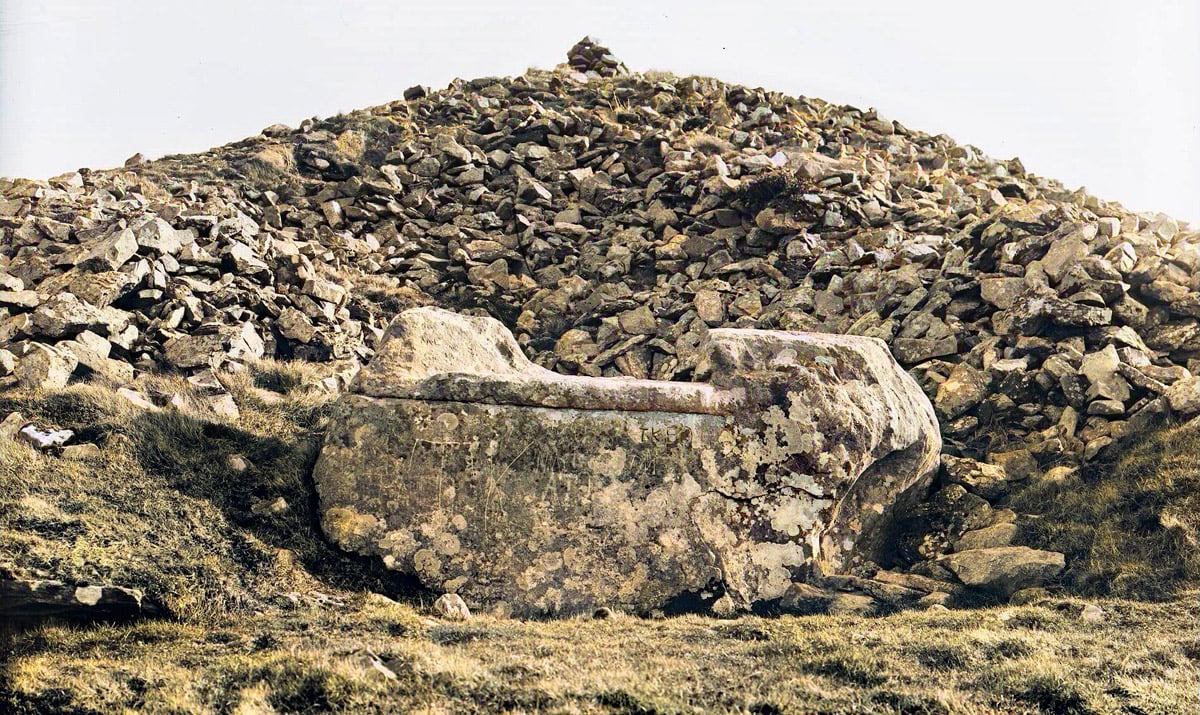
Nestled atop the rolling hills of County Meath, Ireland, the Loughcrew Cairns represent one of the country's most captivating prehistoric sites. Dating back to around 3300 BC, this complex of passage tombs forms part of Ireland's four major megalithic cemeteries, alongside Newgrange, Knowth, and Dowth. Among its many wonders stands the Hag's Chair, a monumental kerbstone that embodies the site's blend of archaeology, astronomy, and mythology. Known locally as "Cataoir na Caillige Bera" or "Calliagh Bera's Chair," this artifact offers a window into Neolithic ingenuity and folklore.
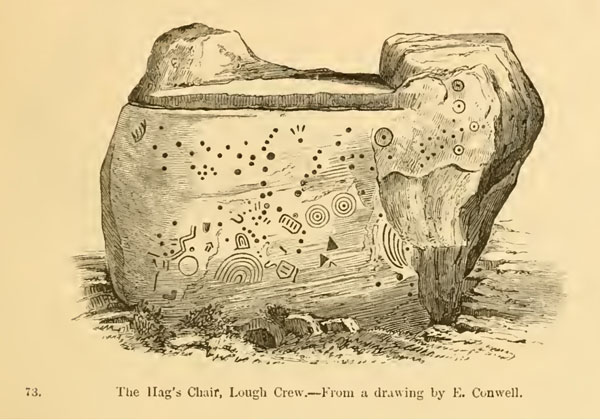
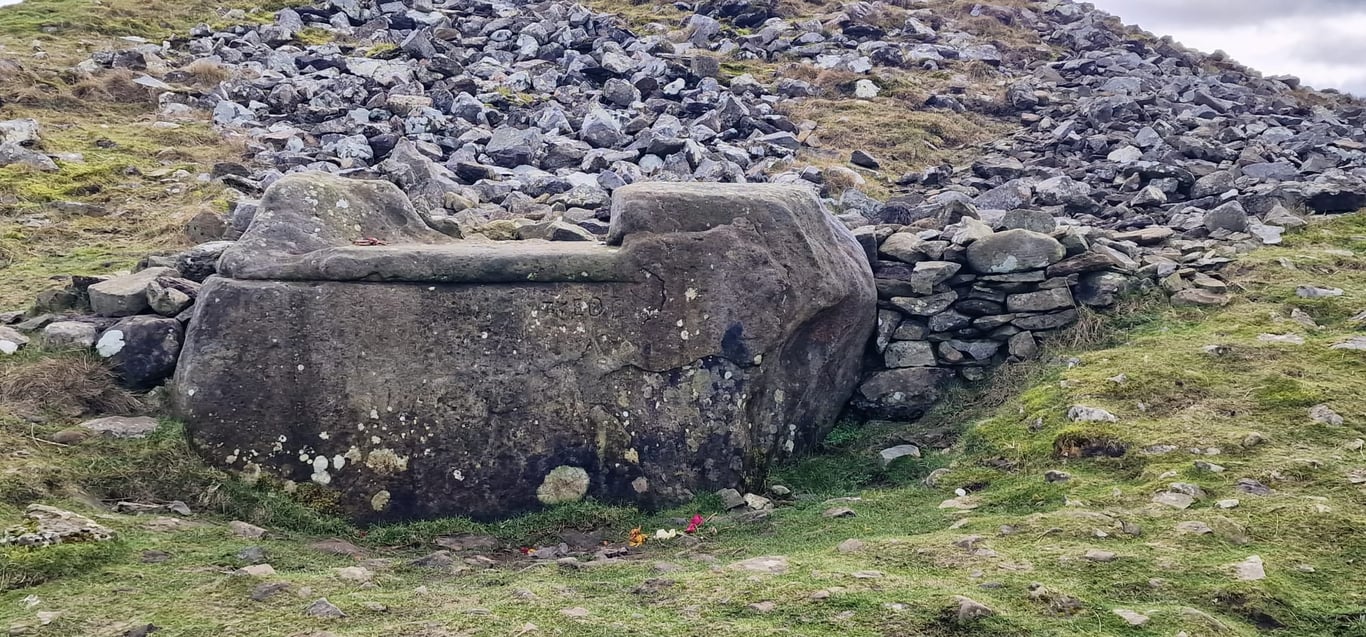
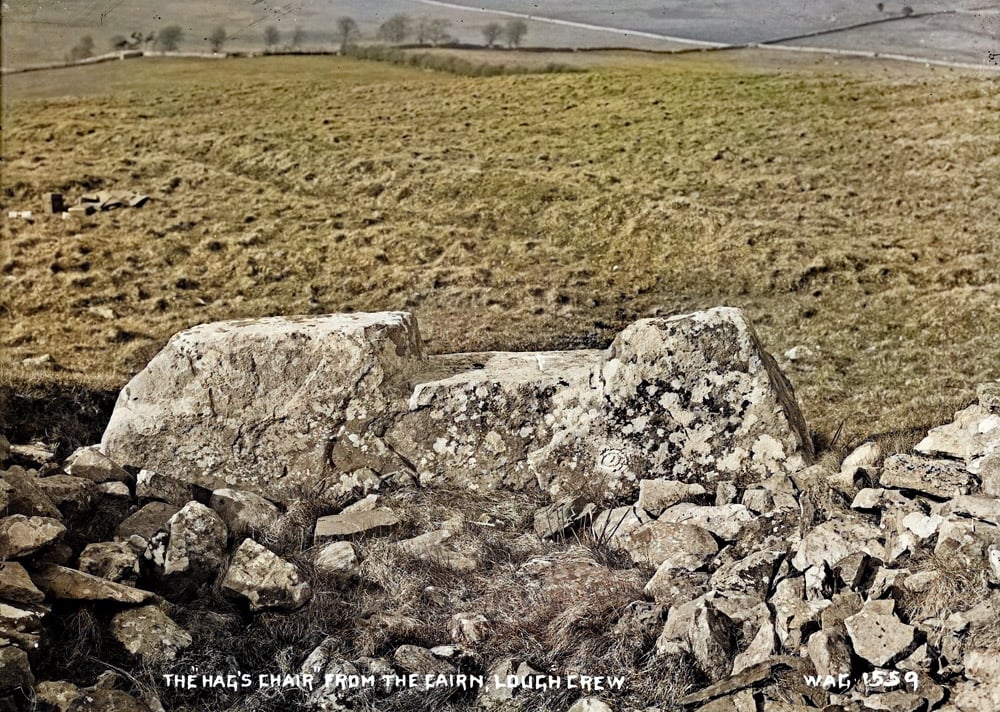
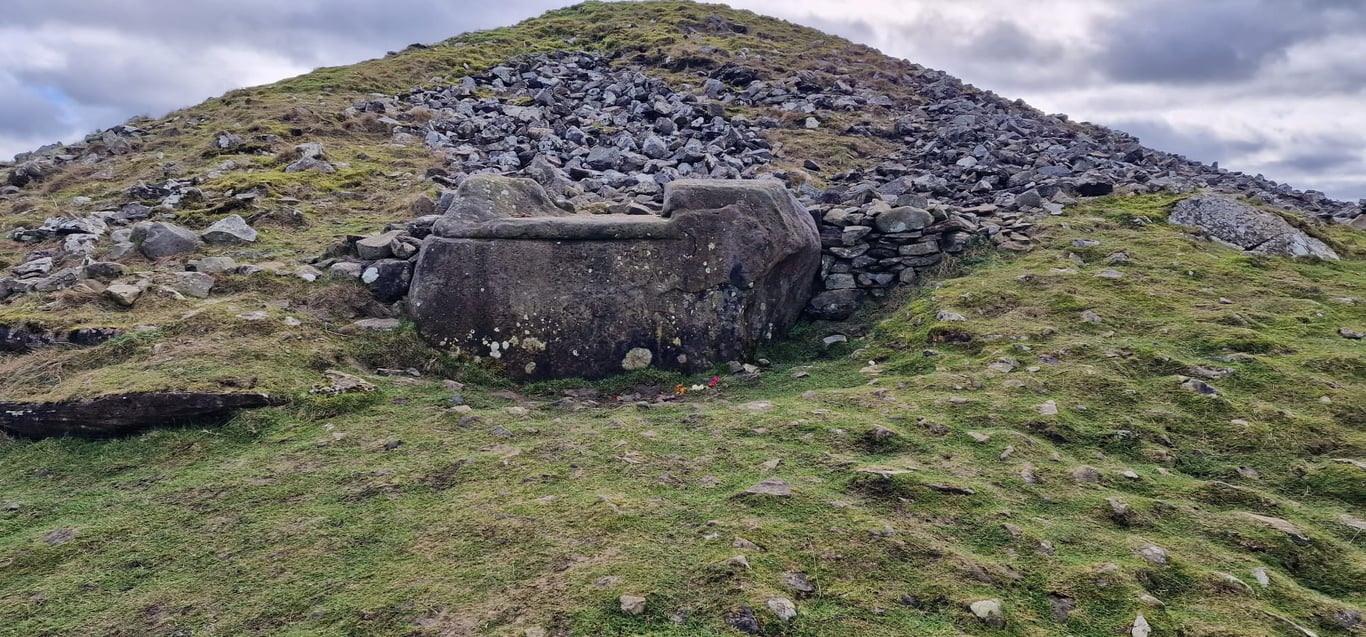
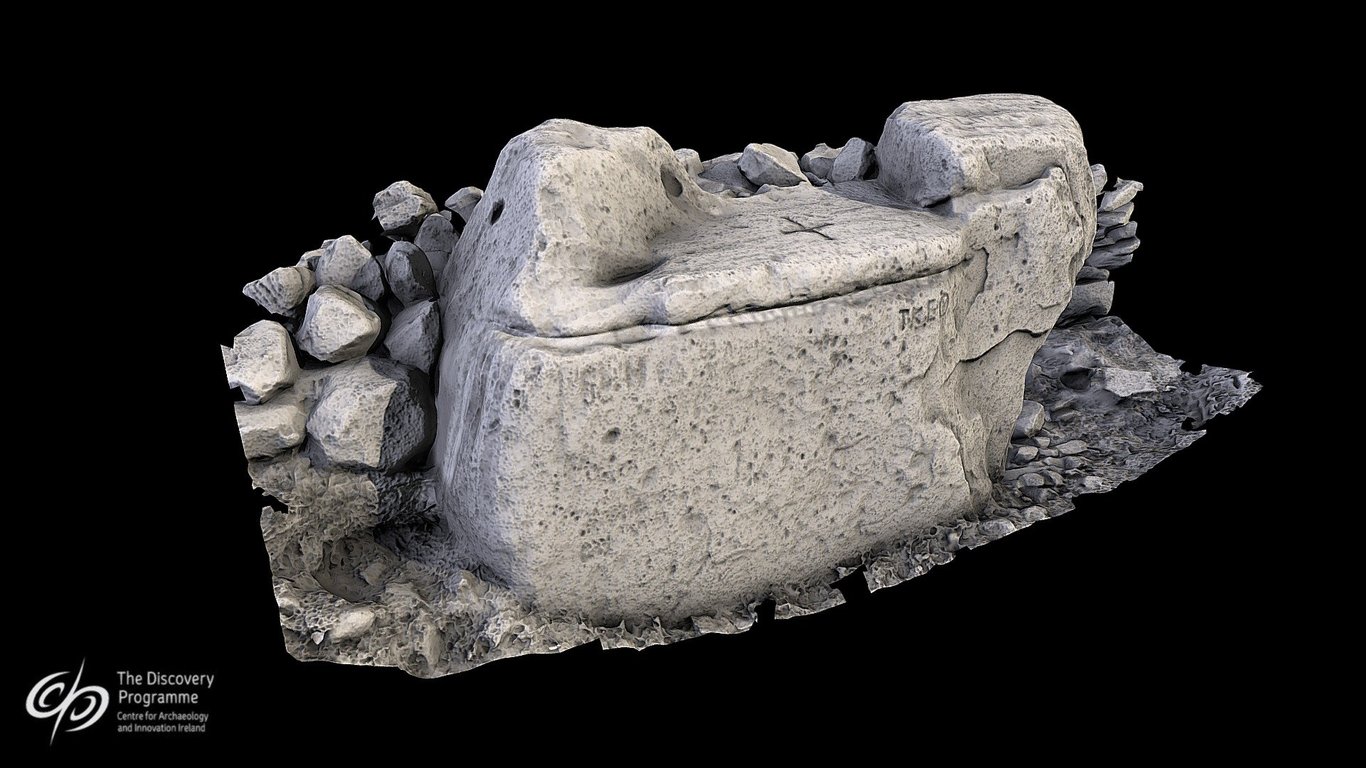
The Hag's Chair is situated on the northern edge of Cairn T, the most elaborate passage grave at Loughcrew's Carnbane East hilltop. This massive erratic boulder, weighing approximately two tons, serves as the largest kerbstone encircling the cairn. Its flat face is adorned with intricate Neolithic carvings, now weathered by millennia of exposure to the elements. These engravings, which include symbols possibly representing stars, cover both the outer and inner surfaces. Early illustrations by antiquarian Eugene Conwell and sketches by Du Noyer capture designs that are faint today, resembling celestial motifs similar to those found at Newgrange. A cross carved into the seat—potentially from the Penal era or by Ordnance Survey workers in 1836—adds a layer of later historical intervention.
Archaeologically, the Hag's Chair is integral to Cairn T's structure, a cruciform chamber mound predating many Boyne Valley monuments by centuries. The site, built around 3500-3400 BC, features over 29 carved stones, with the chair's artwork contributing to a symbolic language of solar and lunar cycles. Excavations in the 19th century by Conwell revealed artifacts like a quartz basin filled with cremated bones buried nearby, hinting at ritualistic practices. The entire Loughcrew complex, protected as a National Monument, showcases unique petroglyphs—lozenges, leaves, and radiating circles—etched into local green gritstone.
Mythologically, the Hag's Chair is tied to the Cailleach, the divine hag of Irish lore, who purportedly constructed the cairns by dropping stones from her apron while traversing the landscape. Folklore depicts her as Garavogue, a star-gazing figure seated on the chair, surveying the stars and terrain from Slieve na Calliagh, meaning "Hill of the Witch." This narrative has transcended Ireland, influencing modern tales like elements in George R.R. Martin's *Game of Thrones* through the works of poet Ella Young.
A key feature is its astronomical alignment. Facing north, the chair complements Cairn T's eastward orientation, where equinox sunrises illuminate internal carvings, including the "Equinox Stone" with sun-like symbols. Discovered by Martin Brennan in 1980, this phenomenon suggests the site's role in tracking celestial events, possibly even a solar eclipse around 3315 BC. Such alignments underscore Neolithic society's advanced understanding of astronomy for agricultural and ritual purposes.
Today, the Hag's Chair draws visitors seeking Ireland's ancient heritage. Restored in the 1880s with a protective concrete roof, it stands as a testament to preservation efforts amid weathering threats. As part of Loughcrew's UNESCO-recognized potential, it invites reflection on how prehistoric peoples wove myth, art, and science into stone, enduring through the ages.
In the rich tapestry of Irish mythology, the Hag's Chair resonates with the archetype of An Cailleach Bhéara, a primordial Earth Mother and sovereignty goddess embodying both creation and destruction. Often linked to Buí, an ancient cow deity associated with fertility and the flowing rivers, she represents the dark facet of the Mother Goddess, wielding geotectonic might to sculpt valleys, forge islands, and invert lakes into peaks. Her eternal essence unfolds through "seven periods of youth," outlasting myriad husbands and descendants, evoking profound melancholy in her ageless vigil. By the ninth century,
Christian scribes recast her as a forlorn figure in "The Lament of the Old Woman of Beare," a poignant poem where she mourns vanished vitality and earthly dominion, seeking solace in faith amid patriarchal shifts. Etymologically rooted in Latin "pallium" for veil, "cailleach" evolved from denoting veiled brides or nuns to a spectral hag-witch, a death-goddess opposing human order. She contrasts Brigid's spring renewal, reigning from Samhain to Imbolc as a winter sovereign, her tales intersecting with war goddesses like Badhbh and Otherworld queens such as Aoibheal or Cliodna. Folklore attributes to her the curious trait of pressing newborns' backs, delaying their first steps—a whimsical yet ominous maternal intervention.
Historically, interpretations of the Hag's Chair weave indigenous lore with scholarly conjecture. Eugene Conwell posited it as the throne of Ollamh Fodhla, Ireland's legendary law-giver, from which edicts were proclaimed under solar reverence, envisioning the site as a judicial epicenter. This narrative, echoed in 1930s accounts, extends to queens like Tailte and Maeve using it for royal decrees, transforming it into a symbol of ancient governance. Conwell and Fergusson reframed the locale as Tailteann's necropolis, overriding hag legends to align with synthetic Irish annals, despite geographical discrepancies. Fringe theories even tie Ollamh to Biblical Jeremiah, importing exotic overlays that clash with native traditions. Such impositions highlight a 19th-century tension between oral folklore and academic historicism, where the chair's role in inauguration or council sessions underscores its perceived authority in pre-Christian rites.
Symbolically, the Hag's Chair evokes themes of female generative power, akin to sheela-na-gig figures representing renewal and wilderness defiance. Its motifs, including cup marks and concentric designs, may encode archaic astronomical lore or ritual continuity, with some elements predating their installation, hinting at reused sacred artifacts. In lore, sitting upon it bestows a solitary wish, infusing it with mystical agency. As a seat of sovereignty, it juxtaposes nurturing fertility against destructive storms, mirroring the Cailleach's dual nature in pre-Indo-European mother-goddess cults. These layers invite contemplation of enduring feminine archetypes in Ireland's cultural heritage.
(Word count: 352)
The Hag's Chair is situated on the northern edge of Cairn T, the most elaborate passage grave at Loughcrew's Carnbane East hilltop. This massive erratic boulder, weighing approximately two tons, serves as the largest kerbstone encircling the cairn. Its flat face is adorned with intricate Neolithic carvings, now weathered by millennia of exposure to the elements. These engravings, which include symbols possibly representing stars, cover both the outer and inner surfaces. Early illustrations by antiquarian Eugene Conwell and sketches by Du Noyer capture designs that are faint today, resembling celestial motifs similar to those found at Newgrange. A cross carved into the seat—potentially from the Penal era or by Ordnance Survey workers in 1836—adds a layer of later historical intervention.
Archaeologically, the Hag's Chair is integral to Cairn T's structure, a cruciform chamber mound predating many Boyne Valley monuments by centuries. The site, built around 3500-3400 BC, features over 29 carved stones, with the chair's artwork contributing to a symbolic language of solar and lunar cycles. Excavations in the 19th century by Conwell revealed artifacts like a quartz basin filled with cremated bones buried nearby, hinting at ritualistic practices. The entire Loughcrew complex, protected as a National Monument, showcases unique petroglyphs—lozenges, leaves, and radiating circles—etched into local green gritstone.
Mythologically, the Hag's Chair is tied to the Cailleach, the divine hag of Irish lore, who purportedly constructed the cairns by dropping stones from her apron while traversing the landscape. Folklore depicts her as Garavogue, a star-gazing figure seated on the chair, surveying the stars and terrain from Slieve na Calliagh, meaning "Hill of the Witch." This narrative has transcended Ireland, influencing modern tales like elements in George R.R. Martin's *Game of Thrones* through the works of poet Ella Young.
A key feature is its astronomical alignment. Facing north, the chair complements Cairn T's eastward orientation, where equinox sunrises illuminate internal carvings, including the "Equinox Stone" with sun-like symbols. Discovered by Martin Brennan in 1980, this phenomenon suggests the site's role in tracking celestial events, possibly even a solar eclipse around 3315 BC. Such alignments underscore Neolithic society's advanced understanding of astronomy for agricultural and ritual purposes.
Today, the Hag's Chair draws visitors seeking Ireland's ancient heritage. Restored in the 1880s with a protective concrete roof, it stands as a testament to preservation efforts amid weathering threats. As part of Loughcrew's UNESCO-recognized potential, it invites reflection on how prehistoric peoples wove myth, art, and science into stone, enduring through the ages.
In the rich tapestry of Irish mythology, the Hag's Chair resonates with the archetype of An Cailleach Bhéara, a primordial Earth Mother and sovereignty goddess embodying both creation and destruction. Often linked to Buí, an ancient cow deity associated with fertility and the flowing rivers, she represents the dark facet of the Mother Goddess, wielding geotectonic might to sculpt valleys, forge islands, and invert lakes into peaks. Her eternal essence unfolds through "seven periods of youth," outlasting myriad husbands and descendants, evoking profound melancholy in her ageless vigil. By the ninth century,
Christian scribes recast her as a forlorn figure in "The Lament of the Old Woman of Beare," a poignant poem where she mourns vanished vitality and earthly dominion, seeking solace in faith amid patriarchal shifts. Etymologically rooted in Latin "pallium" for veil, "cailleach" evolved from denoting veiled brides or nuns to a spectral hag-witch, a death-goddess opposing human order. She contrasts Brigid's spring renewal, reigning from Samhain to Imbolc as a winter sovereign, her tales intersecting with war goddesses like Badhbh and Otherworld queens such as Aoibheal or Cliodna. Folklore attributes to her the curious trait of pressing newborns' backs, delaying their first steps—a whimsical yet ominous maternal intervention.
Historically, interpretations of the Hag's Chair weave indigenous lore with scholarly conjecture. Eugene Conwell posited it as the throne of Ollamh Fodhla, Ireland's legendary law-giver, from which edicts were proclaimed under solar reverence, envisioning the site as a judicial epicenter. This narrative, echoed in 1930s accounts, extends to queens like Tailte and Maeve using it for royal decrees, transforming it into a symbol of ancient governance. Conwell and Fergusson reframed the locale as Tailteann's necropolis, overriding hag legends to align with synthetic Irish annals, despite geographical discrepancies. Fringe theories even tie Ollamh to Biblical Jeremiah, importing exotic overlays that clash with native traditions. Such impositions highlight a 19th-century tension between oral folklore and academic historicism, where the chair's role in inauguration or council sessions underscores its perceived authority in pre-Christian rites.
Symbolically, the Hag's Chair evokes themes of female generative power, akin to sheela-na-gig figures representing renewal and wilderness defiance. Its motifs, including cup marks and concentric designs, may encode archaic astronomical lore or ritual continuity, with some elements predating their installation, hinting at reused sacred artifacts. In lore, sitting upon it bestows a solitary wish, infusing it with mystical agency. As a seat of sovereignty, it juxtaposes nurturing fertility against destructive storms, mirroring the Cailleach's dual nature in pre-Indo-European mother-goddess cults. These layers invite contemplation of enduring feminine archetypes in Ireland's cultural heritage.
(Word count: 352)
The Hag's Chair — photo gallery
The Hag's Chair — collectible cards
Collectible cards for this site — AI-generated illustrations from our memory game, not photographs of the site.